Sentry Page Protection
How to Build Your Stockpile Part 2
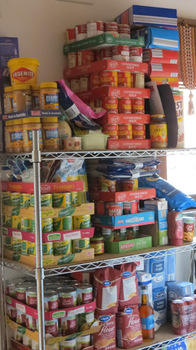
Way back when I first started monthly grocery shopping and stockpiling, I realised pretty quickly that we use basically the same groceries month after month, with slight changes to the list to accommodate changes in season: the summer list is slightly different to the winter list. Otherwise I'm a very boring shopper :)
Boring it may be, but it makes it very easy to build a stockpile within my grocery budget.
Before I go shopping I always do a quick inventory of the pantry, fridge and freezer, then write my shopping list according to the gaps in the inventory.
When you start to build your stockpile I suggest you inventory your pantry, fridge and freezer too. It will very quickly show you the gaps, what you have enough of and what you won't need to buy for another two years (or so….).
Doing the inventories will also give you a chance to tidy the pantry, clean the fridge and defrost the freezer. These three food storage areas need to be ready to start taking your stockpile as you build it.
If you need to rearrange things do; I've swapped the tea and coffee from the top shelf in the pantry to an overhead cupboard in the kitchen that just had vases (very ugly vases), odd glasses and a couple mugs in it. Those things have all been donated to the op shop. Now the cupboard holds 12 boxes of tea bags, four 500g tins of Nescafe (on sale this week for $14.99 at IGA stores), four boxes of hot chocolate pods and 24 boxes of coffee pods. And the pantry shelf is free to hold other things I use more often.
It is important to remember, as you start to stockpile, to keep things handy and like with like. If they are too hard to get to you'll forget where they are or worse still, just not bother to dig them out. And that's money down the drain, another reason to organise your food storage!
Keeping like with like just means keeping tins together, baking ingredients together, cereals together, condiments together and on.
Once you've done your inventories, you'll be able to calculate how much of each thing you need to last the length of your stockpile. At the moment I'm aiming for 12 months of everything for my family of five.
There is a (perhaps) handy sheet you can download here (link courtesy of The Prudent Homemaker) that will tell you roughly how much of each thing you'll need per person for a year.
I'm not sure the quantities are quite accurate - according to this table I'd need to stockpile 104 kilos of pasta and 154 kilos of rice! As we eat lots of different foods, those quantities are not right for us, but they give you an idea of just how big your stockpile will need to be.
I've calculated that I will need 30 kilos of pasta - a huge difference. We eat one pasta dish a week (my boys love pasta!) and I use approximately 500g of spaghetti or noodles each time. That equates to 26 kilos a year. Adding a couple of kilos for pasta salads and casseroles brings the total for the year to 30 kilos - for the five of us. By the way, I have pasta covered - there is 37 kilos in the stockpile at the moment, enough for the next 15 months.
Twenty kilos of rice will be enough, that's what I buy each year now. Yes, we eat a lot of rice, in savoury and sweet dishes, mainly because I just like it and not just because it's cheap :)
Take a look at the sheet and see how the numbers compare to what you've estimated you'll need after doing your inventories. You might be a little surprised, like I was, or you could be completely in agreement.
How much you need to stockpile will depend on your family's size, how long you want the stockpile to last, what you eat and/or use and how much of each thing you use and/or eat and where you are going to store it.
In Part 3 I'll share the things I'm stockpiling, the quantities I've estimated we will need for one year and where in the house it's all going to be stored.
Boring it may be, but it makes it very easy to build a stockpile within my grocery budget.
Before I go shopping I always do a quick inventory of the pantry, fridge and freezer, then write my shopping list according to the gaps in the inventory.
When you start to build your stockpile I suggest you inventory your pantry, fridge and freezer too. It will very quickly show you the gaps, what you have enough of and what you won't need to buy for another two years (or so….).
Doing the inventories will also give you a chance to tidy the pantry, clean the fridge and defrost the freezer. These three food storage areas need to be ready to start taking your stockpile as you build it.
If you need to rearrange things do; I've swapped the tea and coffee from the top shelf in the pantry to an overhead cupboard in the kitchen that just had vases (very ugly vases), odd glasses and a couple mugs in it. Those things have all been donated to the op shop. Now the cupboard holds 12 boxes of tea bags, four 500g tins of Nescafe (on sale this week for $14.99 at IGA stores), four boxes of hot chocolate pods and 24 boxes of coffee pods. And the pantry shelf is free to hold other things I use more often.
It is important to remember, as you start to stockpile, to keep things handy and like with like. If they are too hard to get to you'll forget where they are or worse still, just not bother to dig them out. And that's money down the drain, another reason to organise your food storage!
Keeping like with like just means keeping tins together, baking ingredients together, cereals together, condiments together and on.
Once you've done your inventories, you'll be able to calculate how much of each thing you need to last the length of your stockpile. At the moment I'm aiming for 12 months of everything for my family of five.
There is a (perhaps) handy sheet you can download here (link courtesy of The Prudent Homemaker) that will tell you roughly how much of each thing you'll need per person for a year.
I'm not sure the quantities are quite accurate - according to this table I'd need to stockpile 104 kilos of pasta and 154 kilos of rice! As we eat lots of different foods, those quantities are not right for us, but they give you an idea of just how big your stockpile will need to be.
I've calculated that I will need 30 kilos of pasta - a huge difference. We eat one pasta dish a week (my boys love pasta!) and I use approximately 500g of spaghetti or noodles each time. That equates to 26 kilos a year. Adding a couple of kilos for pasta salads and casseroles brings the total for the year to 30 kilos - for the five of us. By the way, I have pasta covered - there is 37 kilos in the stockpile at the moment, enough for the next 15 months.
Twenty kilos of rice will be enough, that's what I buy each year now. Yes, we eat a lot of rice, in savoury and sweet dishes, mainly because I just like it and not just because it's cheap :)
Take a look at the sheet and see how the numbers compare to what you've estimated you'll need after doing your inventories. You might be a little surprised, like I was, or you could be completely in agreement.
How much you need to stockpile will depend on your family's size, how long you want the stockpile to last, what you eat and/or use and how much of each thing you use and/or eat and where you are going to store it.
In Part 3 I'll share the things I'm stockpiling, the quantities I've estimated we will need for one year and where in the house it's all going to be stored.